View Catalogue
Sakti Burman draws from many sources; Greek and Hindu mythology, Biblical narratives and mediaeval European passion plays, puppet theatre, scroll painting, the Mughal and Rajput miniature ateliers, Kalighat and Bengali popular culture. In the painting and bas-relief on display, Sakti plays with a version of a recurrent subject of his grandson in Ganapathy playing the flute, surrounded by figures culled from his fecund interior universe: a peacock, a flying figure, a figure on a swing.
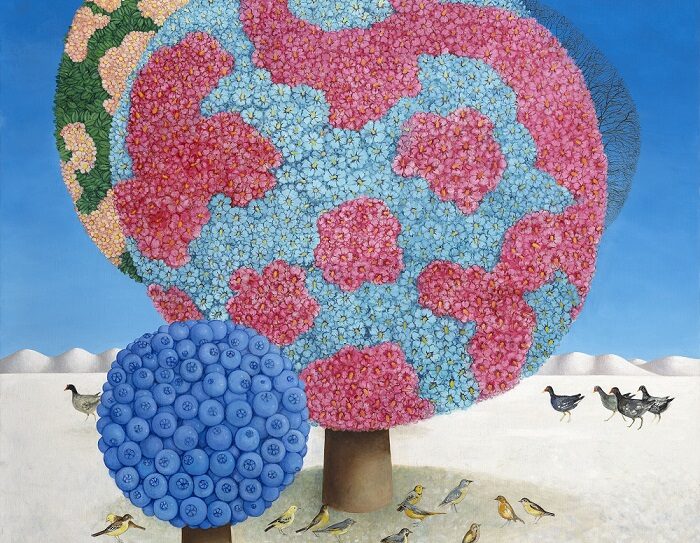
The painting ‘Utopia’ of Maïté Delteil explores the borderland between memory and fantasy, wakefulness and dream. Her brush conveys the roundedness of cherries, the heavy pile of snow, the variegation of the plumage of hoopoes and finches, the particular serration and generic density of foliage. Delteil’s attentiveness to detail is a form of devotion: her paintings are songs of praise.
Anjolie Ela Menon structures her painting around figures who seem to travel to us from distant milieux: sages, nymphs, saints, nomads. The luminosity of her portraits comes from the patina of diaphanous layers that have glided over the surface. This luminosity is seen in her current painting Pastoral, where Anjolie paints the mother and child from her goatherd series. These are based on people she has seen from her studio in a basti of Nizamuddin, a locality known for its famous shrine of Hazrat Nizamuddin and Amir Khusrau.
Jayasri Burman has evolved an iconography that is saturated in the aura of Nature’s nurturing, sustaining, maternal capacities. She invests these capacities in the archetypal figure of the Great Mother, manifested as the Devi, symbolically associated with fertility and plenitude. This is predominant in her recent work on display Padmaja. There is an altar-like quality, depicting Nature as divinity. The imagery in her work has a dream-like and lyrical quality with a unique sensitivity.
Baiju Parthan is an inter-media artist, who shapes his vocabulary from symbols drawn from iconography and alchemy. Scope is about the zone where reasoning has ascended to its utmost to leap into an epiphany. The painting is an adaptation of M.C. Escher’s Penrose steps. Here the artist is presenting the infinite staircase as an object existing in a state of quantum superposition. Bloom is also a reference to the ethno-botanical data that reveals the pivotal role of plant-based entheogens and psychotropic alkaloids in the evolution and development of human cultural and religious realities.
Nilofer Suleman approaches her paintings in the spirit of a storyteller who enjoys nesting one episode inside another, arranging them within framed narratives and larger, circulating cycles of tales. Her protagonists seem to have stepped out of one genre of miniature painting or another. Enter the magical world of Bagh e Wasl, a lover’s garden. There is a kaleidoscopic relay of imagery. In Suleman’s realm of exquisite illusions, jharokhas and chandeliers open onto vistas, and the elements of her architecture are liable to grow wings.
Maya Burman two works on display are peopled by pneumatic figures, depicted in moments of play, and festivity, expressive of an abundant joie de vivre or lila, the cosmic spirit of play and creativity. Maya’s characters live in mythology and metaphor. Her figures float through fields, their bodies curving with the shapes of the landscape. The detailing lends a tapestry like effect where everything is subordinate to floral, decorative patterning, reminiscent of the French art nouveau tradition.
Nikhil Chaganlal’s recent paintings are animated by a deep and complex affection for Goa, a feeling that combines penumbral melancholia with resurgent joy. A passionate regard for Goa’s architecture in its life-affirming diversity, a love of Goa’s unique placeness as articulated through its shapes and structures of habitation and settlement, congregation and worship is present in the works. Chaganlal testifies to the vitality of Goa’s temples, churches, cathedrals, wayside chapels and guardian deity shrines, not asserted against nature but cradled within its luxuriance of forests, shrubbery, groves and wetlands.
Smriti Dixit has long been committed to processes of recycling in her art, incorporating fabric, found objects and plastic tags into her works. In the work on display, Kaali, Smriti is influenced by the changes in the landscape brought about by the creepers and moss that grow after a rainfall. This is the creation of a temporary existence of said creepers, destroying the pre-existence of the Mango, Banyan and Sacred Fig trees. It is a reminder of the feminine energy of Kaali who destroys and provides salvation at the same time, is this the blue of Kaali or of Shiva? Of the body or of the rudraksha? Almost as if blue has been washed by blue to get to Kaali. What if one is neither wholly Shiva nor wholly Kaali?
To enter the pictorial world of Gopikrishna is to be plunged into a pageant of extraordinarily animated fables peopled by monsters, chimaeras, sages, pilgrims, warriors and actors. Travel Sketches from the Mountains, a series of three drawings, dwell on the theme of vision beyond the senses. The figures in them have no eyes but they experience the world through their inner eyes. The terrain they exist is suggestive of loneliness. In a rocky country where pleasures of the civilization are absent, the artist is travelling through. And the sketches are the narration of what he experiences in that trip.
Sheetal Mallar is a contemporary Indian photographer. In her work, she has focused on the delicate, unspoken relationships that bind people to places, and on the layers of active and latent signals by which individuals signal their identity and aspirations. In the series on display, Creatures of Passage, Sheetal explores the emotions we experience while watching a film collectively in a cinema hall alongside a stranger in the next seat. She is drawn to the feeling that resonates in these empty spaces addressing the unspoken relationships that bind people to spaces and the relationship we continue to have with them.
Shilo Shiv Suleman is an artist whose work is sustained by commitments to magical realism, poetry, technology and social justice. In the series on display Queen Conch, Shilo references the ancient timeless tales of the archetypal divine feminine. Aphrodite, Venus, Oshun, Lakshmi, Isis, Chalchiuhtlicue, primeval pre-Islamic goddesses and visions of divine feminine appear. She emerges resplendent, bedecked in silk, shell and gold. As with much of Shilo’s work – this is a darshan, a glance and a remembrance of the sacred feminine in all her forms. Queen Conch makes a softer world of gold and shell, and appears as a revelation, and adoration of the oceanic, primordial feminine.
In the open area of the fair, Shilo Shiv Suleman is displaying Shankha, a large scale installation in brass. With ‘Shankha’, Shilo reclaims the sensuality of India’s architectural past, creating a brass sculpture of a cowrie shell that acts as an object of worship. The cowrie shell in India was considered a valuable measure of trade and economic sustenance, a charm worn by the Banjara community to ward off dark spirits, and a symbol of feminine emergence, fertility and from the Samudra Manthan. It represents the theme – India and the world, but also stands as a symbol for an unabashed Sapphic earth feminine.